Link to: How the engine works
The X-15 is perhaps the most ambitious aircraft ever created. It was built to push the limits of flight
and explore the possibilities of space travel.
During its research program the aircraft set unofficial world speed and altitude records of 4,520 mph
(Mach 6.7 on Oct. 3, 1967, with Air Force pilot Pete Knight at the controls) and 354,200 ft (on Aug. 22, 1963,
with NASA pilot Joseph Walker in the cockpit).
The WADC helped develop the aircraft in coordination with NACA, the Air Force, and the Navy. In the course
of its flight research, the X-15's pilots and instrumentation yielded data for more than 765 research reports.
The X-15 had no landing gear, but rather skidded to a stop in a 200 mph landing on skis. It had reaction
controls for attitude control in space, and was a major step on the path toward space exploration. Much of
what was learned on the X-15 was applied to the Space Shuttle.
The X-15 program, however, was concerned with much more than just dazzling, ultra-performance
records. It generated nearly 800 technical reports on research stimulated by the airplane's
development and flight tests, and it had a profound impact on America's manned space program.
It demonstrated, for example, that pilots could ably perform under the stresses of hypersonic
accelerations, as well as the weightlessness of space. In doing so, it clearly documented man's
ability to pilot a rocket-boosted vehicle out of the atmosphere and then perform a lifting
reentry upon its return. While offering palpable evidence that piloted reusable spacecraft
were a genuine near-term possibility, it was also used as a test bed for a variety of other
space-related experiments. The celestial navigation equipment ultimately destined for use
in the Apollo program, for example, was first tested on the X-15. Generally considered to
be the most productive effort of its kind in history, the X-15 program remains, to this day,
the high-water mark for flight research worldwide.
Specifications of the X-15

Span: 22 ft. 3 in.
Length: 50 ft. 3 in.
Gross weight = 31,275 lbs
Empty weight = 11,374 lbs
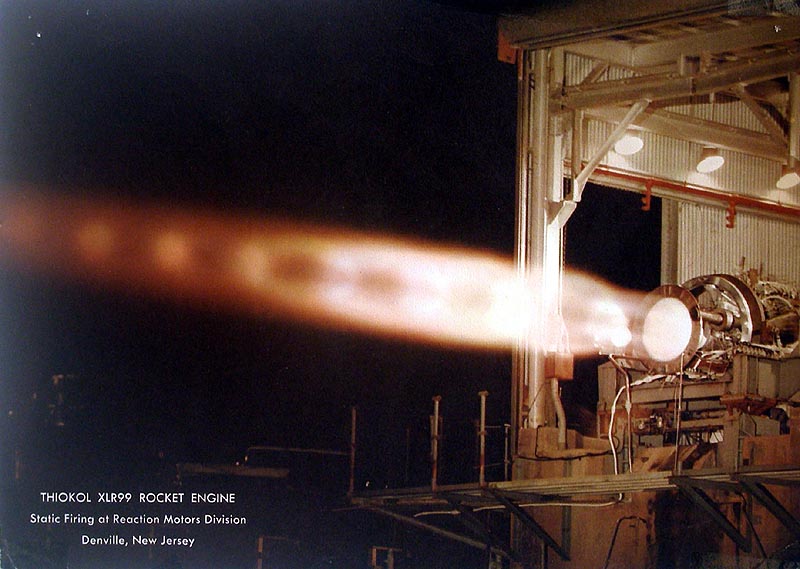
Engine: Reaction Motors XLR-99 rocket
engine, 57,000 lbs. thrust
PERFORMANCE
Maximum speed: Mach 6.72, 4,520 mph. (unoffical
record by X-15 No. 2)
Range: Over 250 miles (flight path
distance)
Service Ceiling: 354,200 ft. (unoffical
record by X-15 No. 3)
Total flight time in the program:
30 hr. 13 mm., 49.2 sec
Total time above Mach: (cumulative)
Mach 1: 18 hr. 23 mm. 11.6 sec
Mach 2: 12 hr. 13 mm. 50 sec
Mach 3: 8 hr. 51mm. 12.8 sec
Mach 4: 5 hr. 57 mm. 23.8 sec
Mach 5: 1 hr. 27 mm. 15.8 sec
Mach 6: 1 mm. 16.8 sec
The Pilots
The 12 pilots of NASA, the Air Force, Navy,
and North American Aviation who flew in the
program are listed in the order of their first flights,
along with their total flight numbers.
A. Scott Crossfleld, NAA, 14 flights
Joseph A. Walker, NASA, 25 flights
Robert M. White, USAF, 16 flights
Forrest S. Petersen, USN, 5 flights
John B. McKay, NASA, 29 flights
Robert A. Rushworth, USAF, 34 flights
Neil A. Armstrong, NASA, 7 flights
Joe H. Engle, USAF, 16 flights
Milton 0. Thompson, NASA, 14 flights
William J. Knight, USAF, 16 flights
William H. Dana, NASA, 16 flights
Michael J. Adams, USAF, 7 flights
The Aircraft Now
The No. 1 X-15, with a serial number of 56-
6670, is publicly displayed in the National Air and
Space Museum, Washington, D.C., next to the
Wright Brothers Flyer and the Spirit of St. Louis,
flown by Charles Lindbergh.
The No. 2 X-15, with a serial number of 56-
6671, is publicly displayed at the Air Force Museum,
Dayton, Ohio. It is displayed in its original
configuration, without the external fuel tanks, though
it retains the fuselage extension. The aircraft was
delivered to the museum in October 1969.
The No.3 X- 15, which carried a serial number
of 56-6672, was destroyed in a crash on Nov. 17,
1967. The pilot, Air Force Maj. Michael J. Adams,
was killed when he lost control in space and was not able to recover.

X15 now residing in the Smithsonian in Washington DC

Rear view complete with engine. The Bell X-1 is in the upper right

Ok, now I know where two of the engines are. We delivered three.
We built a few more but managed to blow up some of them.
I asked where the third engine was. They looked it up on the Intetnet and guess what?
They showed me this web page. I said "Hi, That's my web site".
April 18, 2005
While on vacation I visited the Pima Air and Space Museum in Tucson Arizona
and there next to a mockup of the X-15 was the third engine.
It had been donated with only the information on the plaque so I was able to
enjoy going back about 50 years and explain to the tour guides how it worked.


November 2005, I have just learned that another engine is on display at
Teterboro Airport in New Jersey. (No picture)
February 2006, E-Mail from the Director of the Museum at Edwards Air Force Base
Stumbled on your site while Googling some X-15 stuff. Very interesting and nicely done.
Wasn't sure if you knew that we have two complete XLR-99s (Ser Nos 106 and 107) and a number
of thrust chambers in our collection here at the Air Force Flight Test Center Museum at Edwards
AFB, CA. We were fortunate enough to get the maintenance and inspection logs on each engine
so we could match up which flights each was used on. We had three complete engines at one
time but sent one to the Smithsonian.
S/N 107 was used on Joe Engle's and Milt Thompson's first flights, Engle's astronaut wings
flight, and it set an unofficial world speed record of Mach 5.92 on 27 Jan 62. We have 107 mounted
on a trailer so we can haul it around to airshows and other aerospace events.
S/N 106 had a very distinguished career on the X-15 program from its acceptance in Jan 61 to its
last flight in Nov 66. It was used on the first flight of X-15 #3 in Dec 61; on the first powered
flight of the #2 X-15 modified to the the X-15A-2 configuration in June 1964; on the first X-15A-2
flight with full external fuel tanks in Jul 66; and-during its last flight on 18 Nov 66-it was used
to set an unofficial world's absolute speed record of Mach 6.33 (4250 mph) with William J. "Pete"
Knight at the controls. It reached a maximum altitude of 249,000 feet. This engine is on display
in our museum.
For more information see the Edwards AFB public site at
www.edwards.af.mil Click on "About Edwards" then "Museum" and select the "XLR99 Exhibit."
Best Regards, DOUG NELSON, Director, AFFTC Museum
(661) 277-8050 * DSN 527-8050 - "Keepers of the Right Stuff"
If Edwards has 106 and 107 and they gave 105 to the Smithsonian (may be hard to get the S/N as it's
in the airframe hanging from the ceiling). That would be the three that completed the contract plus
Tuscon, Andrews, Teteboro and the one that we blew up. That would account for 101 through 107
and should be all of them.
|
September 2006 Update. At the Reaction Motors 15th Biennial Reunion I learned from
Ken Gaddis, one of the project engineers, that 10 engines were built. I don't know if the one that
blew on the tie-down test at Edwards due to a valve malfunction was recovered. The third X-15
was destroyed in a crash and I have been told that we blew more than one in testing. This would mean
that the six that I have listed above are all the ones still in existance.
I have included here the 2006 Reaction Motors Rocket Newsletter
rminews06.pdf 16mb.
The 16th Biennial Reunion is scheduled for September 28, 2008 at Zeris Inn, Mountain Lakes, NJ.
I plan on expanding the Reaction Motors information on this site.
Any information you can contribute would be greatly appreciated by everyone.
Here are some links of interest.
Reaction Motors in New Jersey
"POWER FOR PROGRESS": Reaction Motors, Inc., 1941-1972
Viking Rocket
If you have gotten this far on this page then you must be really interested.
I have started a page on How the Engine Works [CLICK HERE]
|
|
Has any one seen this engine?
No, it's not missing. We just can't find out what it is other than a YLR-48.
If anyone recognizes it, please let me know. Thanks

Here are some pictures of the XLR-11 Engine


X-15 launched

X-15 in MicroSoft Flight Sim 2004